Are you interested in buying books for a group or conference? Get SIGNIFICANT discounts when buying direct from the author. Contact Booksales for more information.
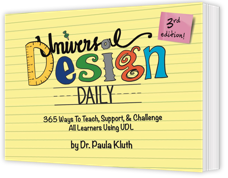
Universal Design Daily
365 Ways to Teach, Support & Challenge All Learners
Are you:
- Tired of your same old assessments?
- Seeking lesson formats that will challenge your students?
- Looking for apps or websites to make learning more accessible?
- In need of ideas that will help you collaborate more creatively?
- Interested in “hacks” you can use to make planning for all more efficient and effective
If you answered “yes” to any or all of these questions, you have chosen the right book to skim; read; re-read; highlight; mark up with pencils, markers, and sticky notes; and share with colleagues! This user-friendly guide will help you learn more about universal design by exploring the practices associated with it.
Keeping up with new models, methods, and materials can feel overwhelming. I designed this book for busy educators like you who may not have time to search websites for hours, attend a series of workshops, or read a multi-chapter book cover-to-cover in order to plan effective and appropriately challenging lessons for all students in the diverse classroom. Learn more at udldaily.com.

From Text Maps to Memory Caps:
100 More Ways to Differentiate Instruction in K-12 Inclusive Classrooms
* Updated in Nov 2017 *
This one-of-a-kind book proves that designing differentiated instruction can be simple and fun! Packed with creative adaptation ideas like fidget bags, doodle notes, and choice boards, this book gives K-12 educators 100 teacher-designed, kid-tested strategies they can use to meet the needs of all students in inclusive classrooms.
Differentiated instruction is simple and fun with this treasure trove of ready-to-use adaptations for grades K-12. All teachers-especially fans of Kluth & Danaher’s From Tutor Scripts to Talking Sticks-will love the 100 creative NEW ideas in this illustrated guide, perfect for meeting the learning needs of all students in inclusive classrooms. An effective, time-saving way to boost student skills in key areas such as literacy, math, organization, communication, and behavior, these research-based adaptations will strengthen and energize any curriculum.

From Tutor Scripts to Talking Sticks:
100 Ways to Differentiate Instruction in K-12 Classrooms
* Updated in Nov 2017 *
This one-of-a-kind book proves that designing differentiated instruction can be simple and fun! Packed with creative adaptation ideas like fidget bags, doodle notes, and choice boards, this book gives K-12 educators 100 teacher-designed, kid-tested strategies they can use to meet the needs of all students in inclusive classrooms.
Everyone in the classroom will benefit from this timely, ultra-practical guidebook the go-to resource for any teacher who has ever had a doubt that differentiated instruction can be simple and fun!

Joyful Learning:
Active and Collaborative Learning in Inclusive Classrooms
* 2nd edition *
Offering all students opportunities for successful learning experiences, this is ideal for K–12 inclusive classrooms and learners with a wide range of abilities, including cultural or linguistic differences. The authors present techniques for using differentiation, active learning, and personalized instruction that enable teachers to use sound teaching practices and engage students in discussion, debate, creative thinking, questioning, teamwork, and collaborative learning.

Don’t We Already Do Inclusion:
100 Ways to Improve Inclusive Schools
Are you trying to grow the inclusive schooling model in your community? Do you feel like you have tried everything to create change in your school? Do you want to “sharpen the saw” and become reenergized as an advocate or educator? If you answered “yes” to any one of these questions, then this is the book for you!
Don’t We Already Do Inclusion? is not only filled with ideas for teaching diverse learners, but is also focused on change itself and, more specifically, on how those concerned about inclusion can create change even when they are not in positions of power. The activities, examples, and illustrations are designed to help participants refine their vision and their skills when it comes to inclusion. The ideas are free or low cost, and many can be achieved by any number of stakeholders—including students and families. Learn tried and true techniques, as well as out-of-the box solutions such as involving traditional and social media, “shrinking” the change, phoning for help, advertising, and writing your way to progress.

You’re Going to Love this Kid!:
Teaching Students with Autism in the Inclusive Classroom
A guide to understanding students with autism and including them fully in the classroom. Includes specific ideas for enhancing literacy; planning challenging, multidimensional lessons; supporting student behavior; connecting, communicating, and collaborating; fostering friendships; and adapting the physical environment.

Just Give Him the Whale!:
15 Ways to Use Fascinations, Areas of Expertise, and Strengths to Support Students with Autism
When learners with autism have deep, consuming fascinations—trains, triangles, basketballs, whales—teachers often wonder what to do. This concise, highly practical guidebook gives educators across grade levels a powerful new way to think about students’ “obsessions”: as positive teaching tools that calm, motivate, and improve learning.

Pedro’s Whale
Based on the real-life event that inspired Paula Kluth and Patrick Schwarz’s bestselling Just Give Him the Whale!, this simple but powerful story introduces educators to one of the best, most effective inclusion strategies: using students fascinations to help them learn.
An ideal teaching tool, Pedro’s Whale will inspire educators to harness their students natural motivations. The engaging, full-color illustrations (by Justin Canha, a gifted artist on the autism spectrum) also make this book perfect for storytime, so all children can increase their sensitivity to peers with special needs and learning differences.

